



Calcium Channel
Ca2+ channels; Ca channels
Calcium channel is an ion channel which displays selective permeability to calcium ions. It is sometimes synonymous as voltage-dependent calcium channel, although there are also ligand-gated calcium channels. Voltage-gated calcium (CaV) channels catalyse rapid, highly selective influx of Ca2+ into cells despite a 70-fold higher extracellular concentration of Na+. Some calcium channel blockers have the added benefit of slowing your heart rate, which can further reduce blood pressure, relieve chest pain (angina) and control an irregular heartbeat.
Calcium Channel Isoform Specific Products
All Product Categories
-
Calcium Channel Inhibitors
(585)
View all products
-
Calcium Channel Agonists
(35)
View all products
-
Calcium Channel Antagonists
(210)
View all products
-
Calcium Channel Activators
(86)
View all products
-
Calcium Channel Modulators
(45)
View all products
-
Calcium Channel Chemical
(1)
View all products
-
Calcium Channel Inducers
(11)
View all products
-
Calcium Channel Controls
(10)
View all products
-
Calcium Channel Ligands
(7)
View all products
-
Calcium Channel Related Products (1226)
Related Products (1226)

-
Antibodies (29)
-
Related Compound Screening Libraries (1)
-
Calcium Channel Isoform Comparison
-
Amlodipine metabolite
 0 ImagesCat. No.: HY-W704938CAS No.: 113994-45-9
-
Nesapidil
 0 ImagesCat. No.: HY-187768CAS No.: 90326-85-5Nesapidil is an antiarrhythmic agent and calcium channel blocker. Nesapidil slows calcium channel activity, which in turn causes slowing of atrioventricular conduction and sinus heart rate. Nesapidil alters preload, afterload, contractility, and coronary blood flow. Nesapidil can be used in research related to arrhythmia and hypertensionsup>[1].
-
Flunarizine (Standard)
 0 ImagesFlunarizine (Standard) is the analytical standard of Flunarizine. This product is intended for research and analytical applications. Flunarizine is a potent dual Na+/Ca2+ channel (T-type) blocker. Flunarizine is a D2 dopamine receptor antagonist. Flunarizine shows anticonvulsive and antimigraine activity, and peripheral vasodilator effects.
-
Nisoldipine-d4
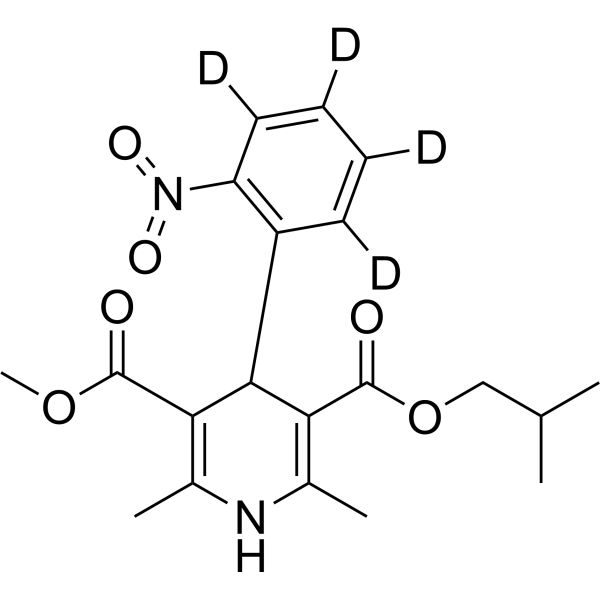 0 ImagesCat. No.: HY-17402S1CAS No.: 1219795-47-7Nisoldipine-d4 (BAY-k 5552-d4) is the deuterium labeled Nisoldipine. Nisoldipine(BAY-k 5552) is a calcium channel blocker belonging to the dihydropyridines class, specific for L-type Cav1.2 with IC50 of 10 nM.
-
Diproteverine
 0 ImagesCat. No.: HY-114638CAS No.: 69373-95-1Synonyms: BRL 40015Diproteverine (BRL 40015) is an oral activity calcium channel blocker. Diproteverine embryonic toxicity. Diproteverine also shows antianginal properties.
-
(2R/S)-6-PNG (Standard)
 0 ImagesCat. No.: HY-115681RCAS No.: 68682-01-9Synonyms: 6-Prenylnaringenin (Standard); (±)-6-Prenylnaringenin (Standard)(2R/S)-6-PNG (Standard) is the analytical standard of (2R/S)-6-PNG. This product is intended for research and analytical applications. (2R/S)-6-PNG (6-Prenylnaringenin) is a potent and reversible Cav3.2 T-type Ca2+ channels (T-channels) blocker. (2R/S)-6-PNG can penetrate the blood-brain barrier (BBB). (2R/S)-6-PNG suppresses neuropathic and visceral pain in mice.
-
Rhodojaponin VI
 0 ImagesRhodojaponin VI is an orally active diterpenoid compound found in hododendron molle G. Don
(Ericaceae) (RM). Rhodojaponin VI binds rat N-Ethylmaleimide-sensitive fusion (NSF) with a Kd of 1.03 μM. Rhodojaponin VI blocks the MDM2-Notch1 signalling pathway by reducing MDM2 and Notch1 expression. Rhodojaponin VI indirectly reduces Cav2.2 current intensity by inhibiting NSF-mediated Cav2.2 trafficking. Rhodojaponin VI alleviates glomerulonephritis progression and podocyte injury in passive heymann nephritis rats. Rhodojaponin VI also has antinociceptive effects. Rhodojaponin VI can be used for the researches of heymann nephritis and pain.
-
TTA-Q6(isomer) (Standard)
 0 ImagesCat. No.: HY-10388ARCAS No.: 910484-32-1TTA-Q6(isomer) (Standard) is the analytical standard of TTA-Q6(isomer) (HY-10388A). This product is intended for research and analytical applications. TTA-Q6(isomer) is an isomer of TTA-Q6. TTA-Q6 is a selective T-type Ca2+ channel antagonist.
-
Glycerophosphoinositol 4,5-diphosphate trisodium
 0 ImagesCat. No.: HY-171899ASynonyms: GroPI(4,5)P2 trisodium; GPIP2 trisodiumGlycerophosphoinositol 4,5-diphosphate (GroPI(4,5)P2) trisodium is a slowly metabolized analog of InsP3. Glycerophosphoinositol 4,5-diphosphate trisodium has an EC50 of 1.228 μM for inducing calcium release, with a degradation time constant of 13 seconds. Glycerophosphoinositol 4,5-diphosphate trisodium can be used to study the effect of InsP3 degradation on calcium signal recovery.
-
PD-151307
 0 ImagesCat. No.: HY-118974CAS No.: 225925-12-2PD-151307 is an N-type calcium channel antagonist with significant inhibitory effects in IMR-32 human neuroblastoma cells, exhibiting an IC50 of 0.32 µM. PD-151307 can be used in research related to cancer therapy, anticonvulsants, and neuropathic pain.
-
Gabapentin enacarbil (Standard)
 0 ImagesCat. No.: HY-16216RCAS No.: 478296-72-9Synonyms: XP-13512 (Standard)Gabapentin enacarbil (Standard) is the analytical standard of Gabapentin enacarbil. This product is intended for research and analytical applications. Gabapentin enacarbil (XP-13512) is a prodrug of Gabapentin (HY-A0057) designed to be absorbed throughout the intestine by high-capacity nutrient transporters. Gabapentin is a potent, orally active P/Q type Ca2+ channel blocker. Gabapentin enacarbil can be used for the study of Restless Legs Syndrome (RLS) and postherpetic neuralgia (PHN).
-
NNC 09-0026
 0 ImagesCat. No.: HY-187014CAS No.: 141360-03-4NNC 09-0026 is a neuronal calcium channel inhibitor. NNC 09-0026 exhibits IC50 values of 10 μM and 13 μM against neuronal L-type voltage-gated calcium channels, and an IC50 value of 13 μM against rat neuronal N-type voltage-gated calcium channels, with higher selectivity for neuronal L-type channels over peripheral L-type channels. NNC 09-0026 inhibits voltage-dependent Ca2+ channel currents, blocks Ca2+ influx through neuronal L-type and N-type voltage-gated calcium channels, and reduces potassium-stimulated calcium uptake in rat cerebral cortex synaptosomes. NNC 09-0026 inhibits TTX-sensitive Na+ channel currents in rat cerebellar Purkinje neurons. NNC 09-0026 attenuates ischemia-induced neuronal death, infarct volume and neurological deficits in rat models of cerebral ischemia. NNC 09-0026 can be used for studies on global cerebral ischemia, focal ischemia and cerebral ischemia-related research.
-
Hypaconitine (Standard)
 0 ImagesHypaconitine (Standard) is the analytical standard of Hypaconitine. This product is intended for research and analytical applications. Hypaconitine inhibits the KCNH2 current with an IC50 of 8.1 nM, and exhibits cardiotoxicity. Hypaconitine inhibits TGF-β1-induced epithelial-mesenchymal transition (EMT) in A549 cell through the inhibition of NF-κB nuclear translocation. Hypaconitine acts as the neuromuscular blocker. Hypaconitine is orally active.
-
Nilvadipine (Standard)
 0 ImagesSynonyms: FK235 (Standard); FR34235 (Standard)Nilvadipine (Standard) is the analytical standard of Nilvadipine. This product is intended for research and analytical applications. Nilvadipine is a potent calcium channel antagonist, and the IC50 value is around 0.1 nM.
-
Sulcardine hydrochloride
 0 ImagesCat. No.: HY-156976ACAS No.: 343935-48-8Sulcardine hydrochloride is a multi-ion channel blocker that can reduce INa and ICa with IC50 values of 26.9 µM and 69.2 µM, respectively. Sulcardine hydrochloride is a potent hNav1.5 channel blocker with a mild inhibitory effect on hERG channels. Sulcardine hydrochloride has anti-arrhythmic effects.
-
Palmitoylcarnitine chloride (Standard)
 0 ImagesCat. No.: HY-101017RCAS No.: 6865-14-1Eslicarbazepine acetate (Standard) is the analytical standard of Eslicarbazepine acetate. This product is intended for research and analytical applications. Eslicarbazepine acetate (BIA 2-093), an antiepileptic agent, is a dual a dual Inhibitor of β-Secretase and voltage-gated sodium channel.
-
8-Br-7-CH-cADPR
 0 ImagesCat. No.: HY-134269CAS No.: 189876-06-0Synonyms: 7-Deaza-8-bromo-cADPR; 7-Deaza-8-bromo-cyclic ADP ribose8-Br-7-CH-cADPR (7-Deaza-8-bromo-cADPR) is a potent cADPR antagonist. 8-Br-7-CH-cADPR shows partial inhibition of calcium elevation caused by sTIR dimerization. 8-Br-7-CH-cADPR significantly decreases Paclitaxel (HY-B0015)-induced axon degeneration.
-
Topiramate-13C6-1
 0 ImagesCat. No.: HY-B0122SS1Synonyms: McN 4853-13C6-1; RWJ 17021-13C6-1
-
Praeruptorin E (Standard)
 0 ImagesCat. No.: HY-N6066RCAS No.: 78478-28-1Praeruptorin E (Standard) is the analytical standard of Praeruptorin E. This product is intended for research and analytical applications. Praeruptorin E is a main bioactive constituent of Peucedanum praeruptorum (also known as Bai-Hua Qian Hu). Praeruptorin C is a calcium antagonist with pD2′ value of 5.2.
-
Fura-2 leakage resistant AM
 0 ImagesCat. No.: HY-175146Fura-2 leakage resistant AM (Fura-PE3) is a new ratiometric calcium indicator. Fura-2 leakage resistant AM has calcium-binding characteristics (Kd = 146 nM) and fluorescent properties (emission: 510 nm; alternating excitation: 340 nm and 380 nm). Fura-2 leakage resistant AM monitors calcium concentration in platelet.




